In 2007 LEGO realised it had a problem attracting girls to play with their bricks, so they did an anthropological study. The results although not entirely surprising are a lesson for anybody planning to encourage girls into Computer Science and other subjects traditionally considered to be less girly.
Lego suffered from an aesthetic deficit. “The greatest concern for girls really was beauty,” says Hanne Groth, Lego’s market research manager. Beauty, on the face of it, is an unsurprising virtue for a girl-friendly toy, but based on the ways girls played, Groth says, it came, as “mastery” had for boys, to stand for fairly specific needs: harmony (a pleasing, everything-in-its-right-place sense of order); friendlier colors; and a high level of detail.
“It was an education,” recalls Fenella Blaize Holden, an under-30 British designer, on the process of getting Lego Friends made. “No one could understand, why do we need more than one handbag? So I’d have to say, well, is one sword enough for the knights, or is it better to have a dagger, too? And then they’d come around.”
Lego confirmed that girls favor role-play, but they also love to build—just not the same way as boys. Whereas boys tend to be “linear”—building rapidly, even against the clock, to finish a kit so it looks just like what’s on the box—girls prefer “stops along the way,” and to begin storytelling and rearranging. Lego has bagged the pieces in Lego Friends boxes so that girls can begin playing various scenarios without finishing the whole model. Lego Friends also introduces six new Lego colors—including Easter-egg-like shades of azure and lavender. (Bright pink was already in the Lego palette.)
Then there are the lady figures. Twenty-nine mini-doll figures will be introduced in 2012, all 5 millimeters taller and curvier than the standard dwarf minifig. There are five main characters. Like American Girl Dolls, which are sold with their own book-length biographies, these five come with names and backstories. Their adventures have a backdrop: Heartlake City, which has a salon, a horse academy, a veterinary clinic, and a café. “We had nine nationalities on the team to make certain the underlying experience would work in many cultures,” says Nanna Ulrich Gudum, senior creative director.
The key difference between girls and the ladyfig and boys and the minifig was that many more girls projected themselves onto the ladyfig—she became an avatar. Boys tend to play with minifigs in the third person. “The girls needed a figure they could identify with, that looks like them,” says Rosario Costa, a Lego design director. The Lego team knew they were on to something when girls told them, “I want to shrink down and be there.”
Raspberry Pi with PiBow casing
The Lego Friends team is aware of the paradox at the heart of its work: To break down old stereotypes about how girls play, it risks reinforcing others. “If it takes color-coding or ponies and hairdressers to get girls playing with Lego, I’ll put up with it, at least for now, because it’s just so good for little girls’ brains,” says Lise Eliot. A neuroscientist at the Rosalind Franklin University of Medicine and Science in Chicago, Eliot is the author of Pink Brain Blue Brain, a 2009 survey of hundreds of scientific papers on gender differences in children. “Especially on television, the advertising explicitly shows who should be playing with a toy, and kids pick up on those cues,” Eliot says. “There is no reason to think Lego is more intrinsically appealing to boys.”
So one can see why iPads and Apple Macs might be the first choice of discerning ladies, because the aesthetics are pleasing to the eye.
Our challenge in Computer Science is to make it more social, to make it more design oriented and to show that it has value for both genders. Quite frankly there's no reason why Computer Science is not seen as an excellent career choice for both genders. Perhaps even something as simple as PiBow could make Computer Science more attractive. I know my five year old daughter loves its colours and design.
There are some fantastic projects such as that being done by London Zoo, the Bird box from Manchester University and social media programming that should be equally attractive to boys and girls.
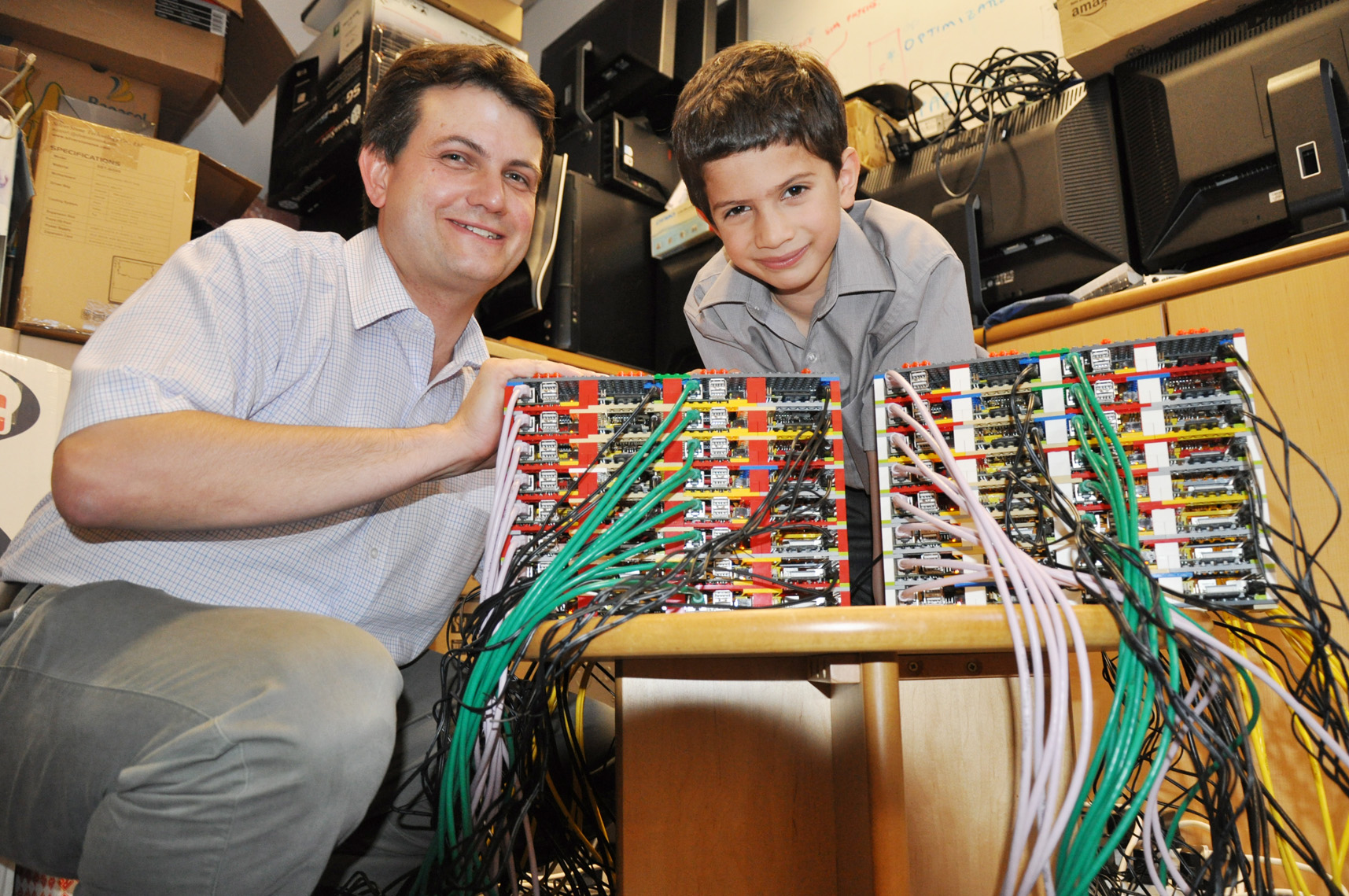
A team at Southampton University have built a SuperComputer using 64 Raspberry Pis and LEGO.
The team, led by Professor Simon Cox, consisted of Richard Boardman, Andy Everett, Steven Johnston, Gereon Kaiping, Neil O’Brien, Mark Scott and Oz Parchment, along with Professor Cox’s son James Cox (aged 6) who provided specialist support on Lego and system testing.
Professor Cox comments: “As soon as we were able to source sufficient Raspberry Pi computers we wanted to see if it was possible to link them together into a supercomputer. We installed and built all of the necessary software on the Pi starting from a standard Debian Wheezy system image and we have published a guide so you can build your own supercomputer.”
The racking was built using Lego with a design developed by Simon and James, who has also been testing the Raspberry Pi by programming it using free computer programming software Python and Scratch over the summer. The machine, named “Iridis-Pi” after the University’s Iridis supercomputer, runs off a single 13 Amp mains socket and uses MPI(Message Passing Interface) to communicate between nodes using Ethernet. The whole system cost under £2,500 (excluding switches) and has a total of 64 processors and 1Tb of memory (16Gb SD cards for each Raspberry Pi). Professor Cox uses the free plug-in ‘Python Tools for Visual Studio’ to develop code for the Raspberry Pi.
Professor Cox adds: “The first test we ran – well obviously we calculated Pi on the Raspberry Pi using MPI, which is a well-known first test for any new supercomputer.”
“The team wants to see this low-cost system as a starting point to inspire and enable students to apply high-performance computing and data handling to tackle complex engineering and scientific challenges as part of our on-going outreach activities.”
James Cox says: “The Raspberry Pi is great fun and it is amazing that I can hold it in my hand and write computer programs or play games on it.”
It turns out that its relatively easy to power a Pi via cycling. You simply require a Dynamo and the appropriate kit. Whilst this is not a cheap way to power it and will require plenty of pedal power it is very environmentally friendly and enables people to use computers where otherwise it would not be possible.
This is one aspect of the Raspberry Pi that makes it very suitable for use in places where you would not normally put a computer. If you are interested in using a Bicycle to power electronics you can find out more at: http://www.pedalpower.com.au/
Imagine where computers could go and you would not have to worry about the power. Of course another way to power it is with a Wind up mechanism and these can be bought for less than a tenner! Amazon.co.uk
Sony UK Technology Centre (UKTec) in Wales will be manufacturing the Raspberry Pi version 2.0. They will initially manufacture 30,000 units and it will create 30 new jobs.
Mike Buffham, Global Head of EDE at Premier Farnell commented: “When it came to reviewing our manufacturing strategy we were always keen to bring the production of the Raspberry Pi to the UK. From the outset Sony UK Technology Centre demonstrated its enthusiasm for the product as well as its expertise in manufacturing. Their site is highly impressive and I am very confident that the team in Wales can deliver, providing us with a high-quality product, within our designated timeframe, all within budget. The Sony brand is known for its quality and to have its broadcast manufacturing site on board and building the Raspberry Pi product, within the UK, is very exciting.
“Since the Raspberry Pi was launched globally in February 2012 it has been a tremendous success story. The younger generation have been fascinated in learning how to build and programme their own computer device. As such we have had huge interest from educational institutions in purchasing the product, innovative design engineers who are using the computer for exciting new applications and also the general public.”
Eben Upton, Co-Founder of the Raspberry Pi Foundation said: “When Pete Lomas and I built the first Raspberry Pi’s for testing last year, we never dreamed it would become so popular so quickly. The Raspberry Pi was built to develop young people’s skills in computer programming and electronic engineering; we had always intended and hoped that the Raspberry Pi would also be manufactured within the UK. We’re really delighted that Premier Farnell has been able to find such a reliable manufacturer as the Sony UK Technology Centre. By bringing the production of a UK product back into the country alongside its development and distribution, we can help support our economy and demonstrate the capabilities the UK has in terms of technological innovation, invention, and manufacturing.
“We look forward to continuing our work with Premier Farnell and now, the Sony UK Technology Centre, in the Raspberry Pi Foundation’s next stage of growth.”
In the assembly of the Raspberry Pi, Sony UKTec will be investing in additional equipment to fulfil the order requirements, providing flexibility and scalability to cater for potential increases in demand. This will include additional automated circuit board equipment and double side reflow machinery. Furthermore, the site will be extending its manufacturing process capability to include a technique called package-on-package (PoP). This process allows the processor and memory to be stacked on top of each other, reducing the PCB footprint and the distance that high-speed signals need to travel, improving overall reliability.
Steve Dalton OBE, Managing Director of Sony UK Technology Centre, stated; “...the Raspberry Pi Foundation, encompasses our view on developing young people’s knowledge of the technology industry. Organisations like this one help build the technologists of our future by inspiring the next generation.”
He is also a regular writer for Linux User and if you are getting into the Pi and Linux a subscription wouldn't half be a bad idea! http://www.linuxuser.co.uk/ (Shameless Plug)
It also just shows what our young people can achieve when they put their minds to it!
Pi-Face Digital enables the Raspberry Pi to control and manipulate the real world. It allows the Raspberry Pi to read switches connected to it – a door sensor or pressure pad perhaps, a microswitch or reed switch, or a hand held button. With appropriate easy to write code, the Raspberry Pi then drives outputs, powering motors, actuator, LEDs, light bulbs or anything you can imagine to respond to the inputs. It has the following features:
Allows you to control lights, motors etc.
Sense inputs
Creditcard size, stacks on top of Raspberry Pi
Buffered to protect the Raspberry Pi
Easy to connect with screw terminals
Program in Scratch or Python
Test with onscreen simulator
Dr Andrew Robinson presented PiFace at the Cambridge RaspberryJam, here is his presentation in full. Thank you to Leon for the high quality video.