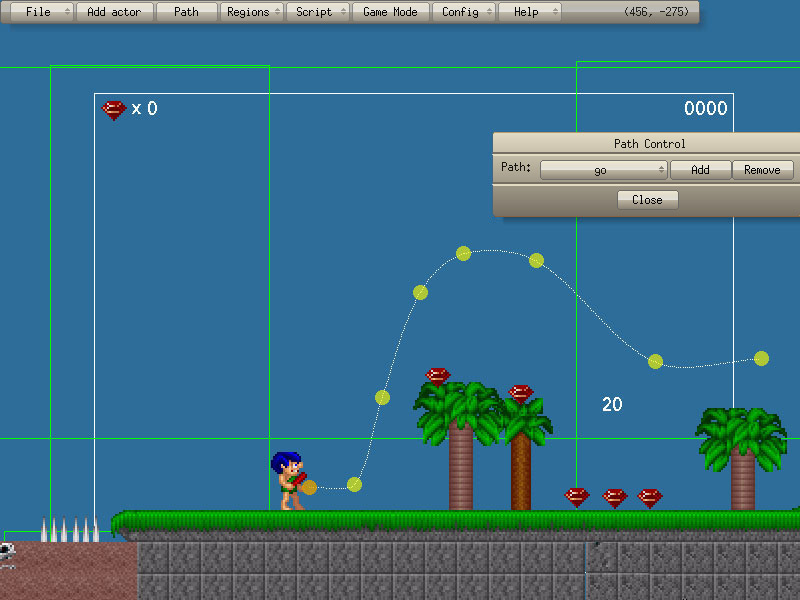
Here are 3 simple tutorials to get you started in Scratch. You will need a TES login for some of these, but most UK teachers will already have one and it only takes about 30 seconds to enter some details for everybody else. Click on the games to play and download them from the main Scratch Website.
When you have a friend with an OFSTED inspection, hoping to teach an invigorating Maths lesson. You could go out and get a Green Screen Studio, multi-million pounds worth of special effects budget and some professionals in... Or you could leave it to us to knock it up for next to nothing....
So how did we do it?
Well firstly, we used a Samsung Camcorder, a script, a nearby television and a video source on a loop. (The Raspberry Pi played the video) We then edited in some library footage and we had a video ready to go.
Look for yourself, considering the DIY nature of the set-up it performed pretty well and opens up a wide range of applications. Imagine the possibilities for students to film themselves anywhere with anything in the background.
It would seem that every time I turn my back there is another games Editor. The classic and probably the one that started the genre is Scratch. Very simple to get started, ideal for primary, but limited in functionality. Scratch (http://scratch.mit.edu/) Microsoft then thought they could make one for X-Box and Windows 7 and make it 3d to boot. Kodu was born: http://www.kodugamelab.com/ It's a lot of fun and a great introduction to some of the key concepts, the only real limiting factor is that you can't design your own sprites.
Now the real gap in the market has been to find something that's a bit more substantial than these kits, but not as complicated as a full-blown programming language.
In 2007 LEGO realised it had a problem attracting girls to play with their bricks, so they did an anthropological study. The results although not entirely surprising are a lesson for anybody planning to encourage girls into Computer Science and other subjects traditionally considered to be less girly.
Lego suffered from an aesthetic deficit. “The greatest concern for girls really was beauty,” says Hanne Groth, Lego’s market research manager. Beauty, on the face of it, is an unsurprising virtue for a girl-friendly toy, but based on the ways girls played, Groth says, it came, as “mastery” had for boys, to stand for fairly specific needs: harmony (a pleasing, everything-in-its-right-place sense of order); friendlier colors; and a high level of detail.
“It was an education,” recalls Fenella Blaize Holden, an under-30 British designer, on the process of getting Lego Friends made. “No one could understand, why do we need more than one handbag? So I’d have to say, well, is one sword enough for the knights, or is it better to have a dagger, too? And then they’d come around.”
Lego confirmed that girls favor role-play, but they also love to build—just not the same way as boys. Whereas boys tend to be “linear”—building rapidly, even against the clock, to finish a kit so it looks just like what’s on the box—girls prefer “stops along the way,” and to begin storytelling and rearranging. Lego has bagged the pieces in Lego Friends boxes so that girls can begin playing various scenarios without finishing the whole model. Lego Friends also introduces six new Lego colors—including Easter-egg-like shades of azure and lavender. (Bright pink was already in the Lego palette.)
Then there are the lady figures. Twenty-nine mini-doll figures will be introduced in 2012, all 5 millimeters taller and curvier than the standard dwarf minifig. There are five main characters. Like American Girl Dolls, which are sold with their own book-length biographies, these five come with names and backstories. Their adventures have a backdrop: Heartlake City, which has a salon, a horse academy, a veterinary clinic, and a café. “We had nine nationalities on the team to make certain the underlying experience would work in many cultures,” says Nanna Ulrich Gudum, senior creative director.
The key difference between girls and the ladyfig and boys and the minifig was that many more girls projected themselves onto the ladyfig—she became an avatar. Boys tend to play with minifigs in the third person. “The girls needed a figure they could identify with, that looks like them,” says Rosario Costa, a Lego design director. The Lego team knew they were on to something when girls told them, “I want to shrink down and be there.”
Raspberry Pi with PiBow casing
The Lego Friends team is aware of the paradox at the heart of its work: To break down old stereotypes about how girls play, it risks reinforcing others. “If it takes color-coding or ponies and hairdressers to get girls playing with Lego, I’ll put up with it, at least for now, because it’s just so good for little girls’ brains,” says Lise Eliot. A neuroscientist at the Rosalind Franklin University of Medicine and Science in Chicago, Eliot is the author of Pink Brain Blue Brain, a 2009 survey of hundreds of scientific papers on gender differences in children. “Especially on television, the advertising explicitly shows who should be playing with a toy, and kids pick up on those cues,” Eliot says. “There is no reason to think Lego is more intrinsically appealing to boys.”
So one can see why iPads and Apple Macs might be the first choice of discerning ladies, because the aesthetics are pleasing to the eye.
Our challenge in Computer Science is to make it more social, to make it more design oriented and to show that it has value for both genders. Quite frankly there's no reason why Computer Science is not seen as an excellent career choice for both genders. Perhaps even something as simple as PiBow could make Computer Science more attractive. I know my five year old daughter loves its colours and design.
There are some fantastic projects such as that being done by London Zoo, the Bird box from Manchester University and social media programming that should be equally attractive to boys and girls.
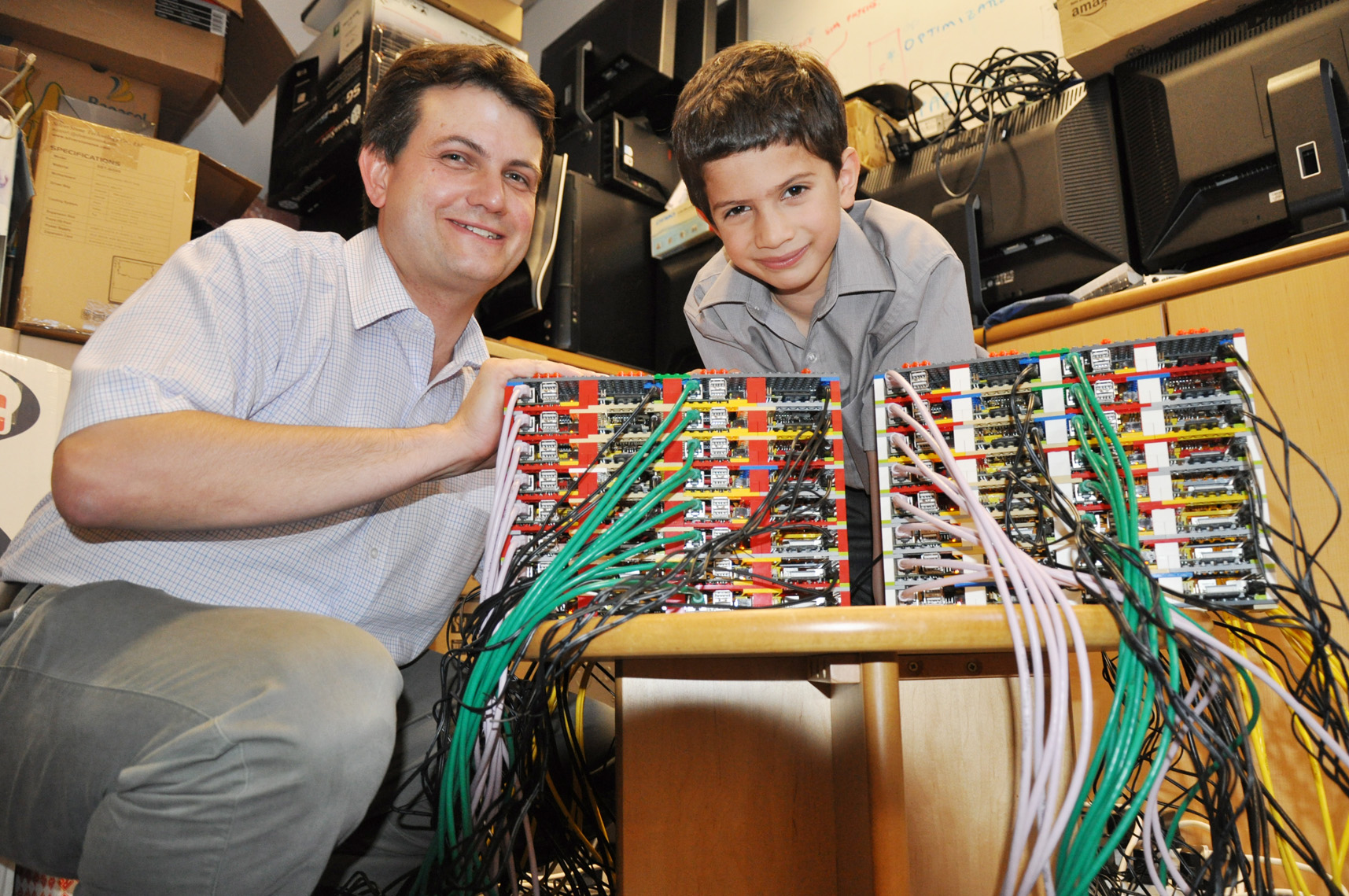
A team at Southampton University have built a SuperComputer using 64 Raspberry Pis and LEGO.
The team, led by Professor Simon Cox, consisted of Richard Boardman, Andy Everett, Steven Johnston, Gereon Kaiping, Neil O’Brien, Mark Scott and Oz Parchment, along with Professor Cox’s son James Cox (aged 6) who provided specialist support on Lego and system testing.
Professor Cox comments: “As soon as we were able to source sufficient Raspberry Pi computers we wanted to see if it was possible to link them together into a supercomputer. We installed and built all of the necessary software on the Pi starting from a standard Debian Wheezy system image and we have published a guide so you can build your own supercomputer.”
The racking was built using Lego with a design developed by Simon and James, who has also been testing the Raspberry Pi by programming it using free computer programming software Python and Scratch over the summer. The machine, named “Iridis-Pi” after the University’s Iridis supercomputer, runs off a single 13 Amp mains socket and uses MPI(Message Passing Interface) to communicate between nodes using Ethernet. The whole system cost under £2,500 (excluding switches) and has a total of 64 processors and 1Tb of memory (16Gb SD cards for each Raspberry Pi). Professor Cox uses the free plug-in ‘Python Tools for Visual Studio’ to develop code for the Raspberry Pi.
Professor Cox adds: “The first test we ran – well obviously we calculated Pi on the Raspberry Pi using MPI, which is a well-known first test for any new supercomputer.”
“The team wants to see this low-cost system as a starting point to inspire and enable students to apply high-performance computing and data handling to tackle complex engineering and scientific challenges as part of our on-going outreach activities.”
James Cox says: “The Raspberry Pi is great fun and it is amazing that I can hold it in my hand and write computer programs or play games on it.”
It turns out that its relatively easy to power a Pi via cycling. You simply require a Dynamo and the appropriate kit. Whilst this is not a cheap way to power it and will require plenty of pedal power it is very environmentally friendly and enables people to use computers where otherwise it would not be possible.
This is one aspect of the Raspberry Pi that makes it very suitable for use in places where you would not normally put a computer. If you are interested in using a Bicycle to power electronics you can find out more at: http://www.pedalpower.com.au/
Imagine where computers could go and you would not have to worry about the power. Of course another way to power it is with a Wind up mechanism and these can be bought for less than a tenner! Amazon.co.uk